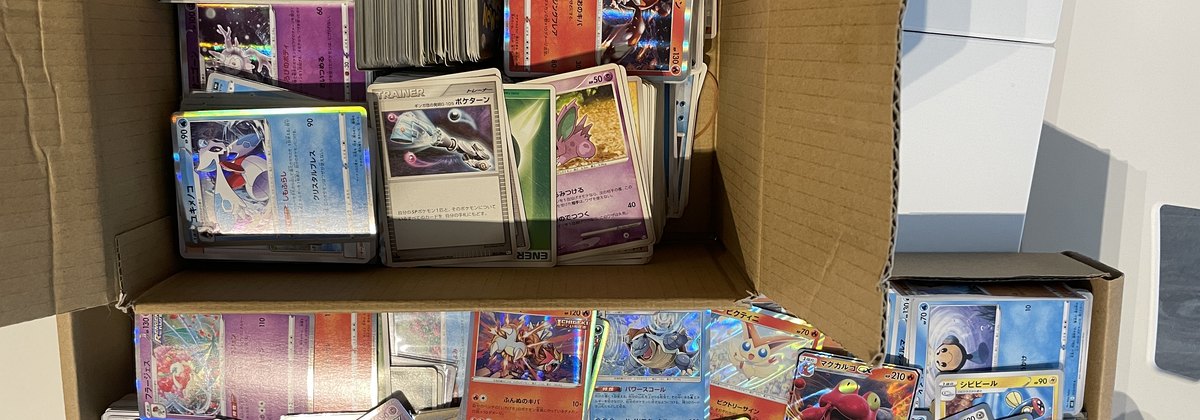
Most of my inventory starts its life in Japan. Across more than fifty proxy orders and thousands of cards, buying Japanese lots has been the single biggest edge in my selling operation, and also where I've paid my most annoying surprise bill. Here's the whole process, with the real costs attached.
Why buy from Japan at all
Japanese singles are often dramatically cheaper than the same card's English version in North America, condition standards among Japanese sellers are famously strict, and lots come up on marketplaces like Yahoo! Auctions and Mercari Japan that simply never appear here. The catch: those marketplaces don't ship internationally or accept foreign payment, which is where proxy services come in.
How proxy services work
A proxy buys the item on your behalf with a Japanese address and payment, receives it at their warehouse, and forwards it to you. You pay for that convenience three ways: a service fee (flat per item or a percentage, structures vary), domestic Japanese shipping to the warehouse, and international shipping to you. I run two in parallel: Buyee for its Yahoo! Auctions reach, and Leyifan, whose fee structure has worked out better on larger lots. Don't take either as gospel, the cheapest proxy genuinely depends on the size and shape of your typical order, so total up all three cost layers for your own case before committing.
A real order, all costs included
Here's the shape of a typical lot for me, in the actual math I run before bidding:
- Auction win: ¥4,000 for a 30-card lot, about C$37 at recent rates
- Proxy service fee: a few hundred yen, or a percentage on bigger wins
- Domestic shipping to the warehouse: usually well under ¥1,000
- International shipping to Canada: about C$25 for a small consolidated box
- Import charges on arrival: see below, the line everyone forgets
Landed cost: roughly C$70, call it C$2.30 per card before eBay ever gets involved. That number is everything. A lot that looks like a steal at auction price can be underwater once you divide the true landed cost per card. I keep a calculator for exactly this, and I don't bid without running it.
The customs surprise that taught me the lesson
My most expensive lesson wasn't a bad lot, it was the border. Living in Ontario, I knew to expect 13% HST on declared value. What I didn't expect was Canada Post's assessment coming in meaningfully above that: the tax is charged on their valuation, plus a handling fee for collecting it, and the total on a larger box ran well past what "13%" had me budgeting. It doesn't hit every shipment, small envelopes often sail through, but if you import regularly, assessments are a matter of when, not if. Budget import charges as a real line on every order and let the ones that skate through be the pleasant surprise instead.
Other mistakes I've already made for you
Letting items sit at the proxy warehouse instead of consolidating promptly (storage fees and clutter add up). Bidding on photo-only lots where the interesting cards were all in the front row, the subject of my lot evaluation guide. And forgetting the 2–3% currency spread on the payment card, which never shows up as a fee but is always there.
Is it worth it?
For me, clearly yes, the per-card landed math works at my price points, Japanese cards sell surprisingly well to North American buyers (more on that in my JP vs EN comparison), and Japanese-language listings still get less competition from Western bidders. Start with one small, cheap lot to learn the pipeline before you put real money through it.