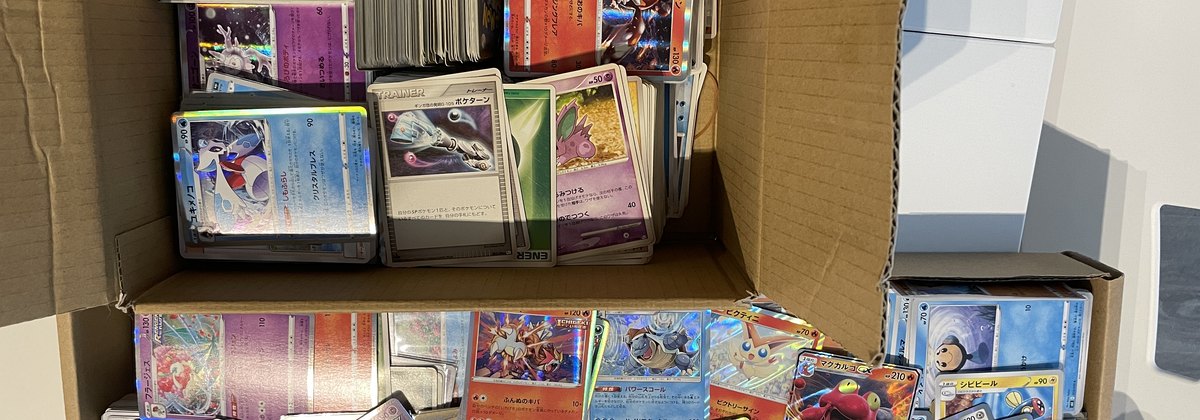
Buying lots is where my margin is made or lost, by the time a card is listed, its profit was mostly decided on the day I bought it. This is the framework I run on every lot before bidding, whether it's a local pickup or a Japanese auction through my import pipeline.
Reading lot photos like a skeptic
Sellers arrange lots to sell them. The cards you can see clearly are the best cards; assume everything obscured is bulk. My photo checklist: are the visible hits actually valuable or just shiny? Can I see edges and surfaces well enough to judge condition? Do the photos show every card or a "representative sample"? Stock photos or one blurry pile shot: I pass, whatever the price.
Per-card cost is the anchor
Total landed cost, price plus shipping plus fees plus import charges, divided by card count. That number against honest expected value: how many cards will realistically sell, at what average price, minus selling fees and supplies? Gut feel says "there's a Charizard in there"; the division says whether the other 290 cards are subsidizing it. My card flip calculator runs this exact math.
Sell-through rate: the number that decides everything
The hard truth of lots: you won't sell every card. My honest historical sell-through on mixed lots runs 50–60%, the rest is bulk that sells slowly, cheaply, or never. So I model every lot at that rate before buying, and here's the rule that's saved me the most money: if the lot only works at 100% sell-through, it doesn't work. Knowing your real number from your own records, rather than an optimistic guess, is worth more than any single buying trick.
How a typical lot of mine plays out
Take the representative ¥4,000, 30-card Japanese lot from my import guide: landed cost about C$70, or C$2.30 per card. At my 50–60% sell-through, call it 16 cards selling at an average of C$6–7, roughly C$100 gross. eBay fees and shipping supplies take their usual third, leaving about C$67 net against C$70 spent... which is why the visible hits matter: the two or three cards worth C$15–25 each are the entire profit, and the math only worked because the photos let me price them before bidding. That's the framework in action, the bulk pays for itself at best; you're really buying the hits at a discount.
Red flags I've learned to walk away from
- "Unsearched" collections, every lot has been searched; the word is bait.
- Hits shown in sleeves but condition never stated, sleeves hide edgewear beautifully.
- Card counts that are suspiciously round ("~500 cards") paired with weight-based descriptions.
- A seller with no card history dumping "a childhood collection" of modern cards.
- Prices that already reflect the hits' full retail, you're paying for the bulk to be free, and bulk isn't free to you: sorting, storing, and listing it costs time.
The discipline compounds: every lot evaluated this way calibrates your instincts for the next one.